

CURRENT ISSUE
Vol. 16, No. 2
JULY-DECEMBER, 2026
Research Notes and Statistics
Obituary
Book Review
From Yield Enhancement to Resilience: Changing Trajectories of CGIAR Innovation in Indian Agriculture
Sherry Rachel Jacob,* Manoj Kumar Patel,* and V. Surjit†
*Indian Council of Agricultural Research (ICAR)-National Bureau of Plant Genetic Resources, New Delhi, sherryrachel@yahoo.co.in
†National Institute of Rural Development and Panchayati Raj, Hyderabad
For nearly half a century, yield enhancement was the principal metric through which agricultural research and technological progress in India were assessed. Higher output per hectare was not merely a technical objective, it was central to addressing food shortages, reducing dependence on imports, and strengthening national food security. The Green Revolution consequently placed strong emphasis on improved varieties capable of delivering higher and reliable yield gains under favourable production environments. The international agricultural research system, including the institutions that subsequently became part of the Consultative Group on International Agricultural Research (CGIAR), was closely aligned with this food production imperative (Evenson and Gollin 2003; Pingali 2012).
Over the past two decades, the circumstances confronting Indian agriculture have, however, changed considerably. India has moved from an era of chronic food supply shortages to one characterised by substantially higher aggregate food production, established national agricultural research institutions and more developed seed and input systems. At the same time, climate variability, water constraints, degradation of natural resources, emerging pests and diseases, and concerns over nutritional quality have become more prominent. Consequently, crop improvement objectives have broadened beyond maximising yield to include yield stability, stress tolerance, resource-use efficiency, nutritional quality, and adaptation to changing production environments (Pingali 2012; Food and Agriculture Organisation [FAO] 2017; CGIAR 2021).
Along with these revised priorities, the concept of varietal superiority is also changing. A variety that delivers very high yield under optimum conditions but suffers a substantial yield penalty under heat, drought, flooding, or disease may be less preferred in a variable production environment than a variety that combines high yield potential with greater yield stability. The emerging objective is therefore increasingly one of high and dependable productivity under a wide range of environments, rather than maximum productivity in a narrowly defined optimum environment. This broader understanding of performance is reflected in current CGIAR research priorities, which explicitly emphasise climate adaptation, sustainable productivity, nutrition, and resilience alongside productivity gains (CGIAR 2021; 2026).
Changing Priorities in CGIAR-linked Innovation in India
The broadening of crop improvement objectives is visible across CGIAR centres working with Indian national agricultural research and extension systems. The International Rice Research Institute (IRRI) has contributed germplasm, breeding materials, and technologies for rice adapted to flooding, drought, salinity, and other stresses; the International Maize and Wheat Improvement Center (CIMMYT) has worked extensively with Indian partners on wheat improvement, including heat tolerance and disease resistance; the International Crops Research Institute for the Semi-Arid Tropics (ICRISAT) has focused strongly on drought adaptation and productivity in dryland crops; the International Potato Center (CIP) has contributed potato germplasm and breeding materials for the development of early maturing, heat- and drought-tolerant, and disease-resistant varieties; and HarvestPlus (a CGIAR-led initiative based at International Food Policy Research Institute that has the mandate of breeding and scaling up of biofortified crops) and CGIAR partners have integrated nutritional traits into mainstream breeding programmes (HarvestPlus 2025).
In all these cases, the breeding objective is broader than just increasing tonnes produced per hectare, although productivity remains a fundamental component of varietal value. By introgressing stress tolerance, the probability and magnitude of yield loss has been reduced and in the case of nutritionally enhanced varieties, the output value of the harvest has been increased.
This distinction is particularly relevant to the Indian context. The country has a large and diverse production environment, ranging from highly irrigated and intensively managed regions to rainfed and less well-managed areas. A single measure of yield potential is therefore inadequate to describe varietal performance across these environments. Multi-environment testing and evaluation under contrasting stresses have consequently become increasingly important components of varietal development and recommendation.
Rice: Breeding for Resilience to Submergence, Drought, Salinity, and Disease
Rice provides one of the clearest examples of how stress tolerance has been incorporated into the breeding of varieties that remain productive under adverse conditions. The development of submergence-tolerant rice through the incorporation of the SUB1 locus into popular varieties illustrates this approach. The SUB1 gene was transferred into widely grown rice backgrounds, including Swarna, resulting in Swarna-Sub1. The objective was to enable plants to survive prolonged submergence while retaining the desirable agronomic and grain-quality characteristics of the original variety (Mackill et al. 2012).
The importance of this innovation lies in the fact that the stress-tolerant variety was designed to protect yield in environments where flooding would otherwise cause severe losses. Evidence from eastern India shows that the adoption of submergence-tolerant varieties can provide substantial yield and income benefits under flood-prone conditions and can reduce yield risk (Dar et al. 2013). In other words, the value of the trait becomes particularly visible when the environment departs from the optimum.
A similar principle applies to drought- and salinity-tolerant rice. Stress tolerance becomes valuable because it allows a crop to retain a greater proportion of its productive potential when water availability or soil conditions become limiting. Disease resistance provides another example. IRRI and national breeding programmes have long exchanged germplasm and resistance sources for major rice diseases, including bacterial blight and blast. Resistance genes are incorporated into locally adapted genetic backgrounds so that varieties can retain acceptable productivity while reducing disease-associated losses.
The rice experience consequently illustrates a broader principle: the economic value of resilience is often greatest when it prevents a large yield loss. A variety that produces the same yield as a conventional cultivar in a favourable season but substantially higher yield during a flood, drought, or disease epidemic (as compared to other improved cultivars) may have greater expected value for farmers than its performance under favourable conditions alone would suggest.
Wheat: From Yield Maximisation to Climate Resilience and Yield Stability
Historically, wheat improvement in India combined yield enhancement with resistance to major diseases, particularly various types of rusts. As wheat productivity in the north-western Indo-Gangetic Plains approached a plateau and climatic stresses became important, breeding priorities increasingly incorporated heat tolerance, adaptation to changing sowing windows, and yield stability.
Wheat yields are highly sensitive to elevated temperatures during grain filling, and a severe heat episode experienced in March 2022 demonstrated the vulnerability of the crop to abrupt temperature increases. An Indian Council of Agricultural Research (ICAR) analysis documented substantial heat stress during the grain filling period and identified several wheat varieties possessing heat tolerance traits (ICAR-Central Research Institute for Dryland Agriculture [CRIDA] 2022).
Wheat Mega Varieties: A Case Study
In recent years, climate-resilient wheat varieties such as DBW 187 (Karan Vandana) and DBW 303 (Karan Vaishnavi), developed by ICAR-IIWBR, and released in 2019 and 2021, have gained considerable prominence among farmers. Area estimates for 2024–25 indicate that DBW 187 and DBW 303 occupied approximately 2.92 million hectares and 0.80 million hectares respectively (personal communication, IIWBR). In 2017, mega wheat varieties HD 2967 and HD 3086 dominated cultivation, occupying approximately 10.76 million hectares and 1.71 million hectares, respectively (Singh 2018; ICAR 2026). However, following the release and widespread adoption of climate-resilient varieties, the seed demand for HD 2967 and HD 3086 declined (Figure 1), indicating a varietal shift in response to evolving climatic risks and farmers’ preference for resilient cultivars.
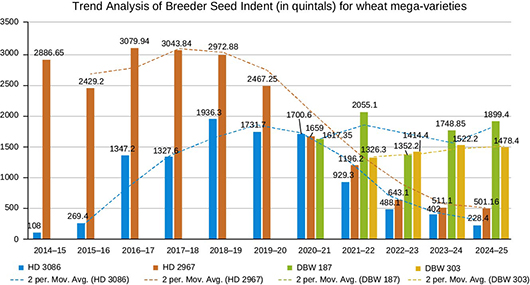
Figure 1 Change in breeder seed indent of wheat varieties: HD 2967, HD 3086, DBW 187, and DBW 303, (2014–15 to 2024–25), India
Notes: Breeder seed refers to the seeds produced at the initial stage of seed multiplication (after variety release), under the direct supervision of the breeder, which possess maximum genetic purity. The quantity of breeder seeds of a particular crop variety demanded by seed production agencies and state governments through the Department of Agriculture and Farmers Welfare (DA&FW), Ministry of Agriculture and Farmers’ Welfare, Government of India, to meet seed production requirements is termed as breeder seed indent.
Wheat varieties HD 2967, HD 3086, DBW 187, and DBW 303 have made significant contributions to wheat production in India. HD 2967 and HD 3086 were developed at ICAR–Indian Agricultural Research Institute, New Delhi, whereas DBW 187 and DBW 303 were developed at ICAR–IIWBR, Karnal.
Check (C) refers to an existing variety that has already been released and is used as a benchmark in field trials. New varieties are grown alongside the checks, to allow comparison of yields.
Source: Indian Institute of Wheat and Barley Research (IIWBR), Karnal, annual reports.
The replacement of HD 2967 and HD 3086 by DBW 187 and DBW 303 can largely be attributed to the superior performance of the latter under adverse climatic conditions, particularly terminal heat stress and late-sown environments. These climate-resilient varieties have demonstrated clear yield advantages under changing weather scenarios, making them better suited for climate adaptation compared to older cultivars (Figure 2).
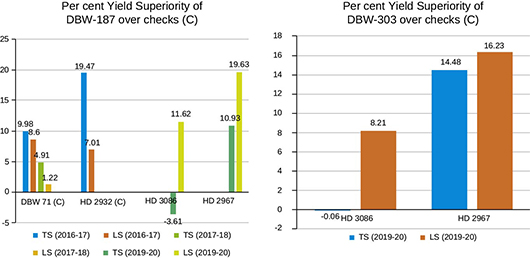
Figure 2 Per cent yield superiority of DBW 187 and DBW 303 over existing checks under timely-sown (TS) and late-sown (LS) conditions during AICRP trials, 2016–17, 2017–18, 2019–20, India
Note: AICRP: All India Coordinated Research Project.
Yield superiority over existing checks refers to a percentage increase in yield of a test variety compared with an existing check (control) variety under the same evaluation conditions.
Source: IIWBR annual reports.
Moreover, their growing acceptance is further reflected in breeder seed demand patterns. DBW 187 accounted for 11.4 per cent and 11.16 per cent of the total wheat breeder seed indent in 2023–24 and 2024–25, respectively, while DBW 303 contributed 9.93 per cent and 8.69 per cent in the corresponding years (Table 1; Tyagi et al. 2024; Ahlawat et al. 2025).
Table 1 Share of DBW 187 and DBW 303 in breeder seed (BS) indent, 2023–24 and 2024–25, India in quintals and per cent
| Variety | BS indent (in quintals) | Total wheat BS indent | Share of variety in total BS indent (in per cent) | BS indent (in quintals) | Total wheat BS indent | Share of variety in total BS indent (in per cent) |
| 2023–24 | 2024–25 | |||||
| DBW 187 (Karan Vandana) | 1748.85 | 15334.25 | 11.4 | 1899.4 | 17020.2 | 11.2 |
| DBW 303 (Karan Vaishnavi) | 1522.2 | 15334.25 | 9.9 | 1478.4 | 17020.2 | 8.7 |
Source: Tyagi et al. (2024); Ahlawat et al. (2025).
Importantly, it has been reported that nearly 70 per cent of the wheat-growing area in India is now covered by climate-resilient wheat varieties (personal communication, IIWBR). Although average wheat productivity remained relatively stable from 2021–22 to 2024–25 (UPAg 2025–26), despite fluctuations in climatic conditions (Figure 3), this stability itself reflects the significant contribution of climate-resilient varieties in safeguarding production. In the absence of such varieties, climatic stress could have resulted in substantial productivity losses. The widespread adoption of climate-resilient wheat varieties has thus played a noteworthy role in enhancing the resilience and stability of India’s wheat production system under changing climatic conditions.
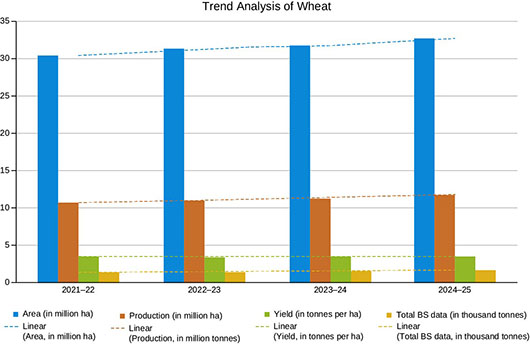
Figure 3 Trend analysis of wheat area, production, productivity, and breeder seed (BS) indent, 2021–22 to 2024–25, India in million ha, million tonnes, tonnes per ha, thousand tonnes
Sources: Unified Portal for Agricultural Statistics (UPAg) and IIWBR annual reports.
These data also imply that the yield that matters increasingly is realised yield under actual production conditions. A variety with a slightly lower yield ceiling but a smaller yield penalty under heat may produce greater and more reliable returns than a variety with a higher theoretical yield but greater climatic sensitivity. This distinction becomes especially important when national production trends are considered. The increase in wheat production in recent years has not been accompanied by a proportionate increase in productivity. The data presented in the accompanying analysis show an increase in wheat area and production between 2021–22 and 2024–25, while average productivity changed only marginally. This suggests that recent production growth has been driven to a much greater extent by area than by gains in yield per unit area. The implication is important: climate-resilient varieties may increasingly be helping protect productivity against climatic losses, but resilience alone cannot be a substitute for continued genetic gains in yield.
This is perhaps the most important lesson from the current wheat transition. India cannot afford to choose between yield and resilience. The appropriate objective is high yield with resilience. Yield potential determines the production ceiling, while resilience determines how much of that potential can be realised when the environment becomes adverse.
ICRISAT and the Dryland Production Environment
The work of ICRISAT provides another illustration of the changing emphasis in crop improvement. Sorghum, pearl millet, chickpea, and pigeon pea are cultivated extensively in rainfed and semi-arid environments where drought, high temperature, and short or erratic growing seasons impose substantial production risks. Breeding programmes for these crops have therefore emphasised drought tolerance, early maturity, disease and pest resistance, and adaptation to variable environments alongside productivity.
In these production systems, a small increase in average yield may be less valuable than the ability to avoid catastrophic losses in a drought year. Short duration varieties, for example, can allow crops to escape terminal drought, while drought-tolerant genotypes can maintain grain formation under water-limited conditions. Recent ICRISAT–ICAR initiatives demonstrate that this emphasis continues to evolve. The development of varieties combining high yield with drought or heat tolerance indicates the increasingly explicit objective of combining productivity and resilience rather than treating them as alternatives (ICRISAT 2026). This is especially important in dryland agriculture, where climate variability directly translates into production variability.
Thus, the dryland experience reinforces the central argument emerging from wheat and rice: resilience has value because it protects productive capacity.
Nutrition: Expanding the Definition of Varietal Value
The broadening of crop improvement objectives is also evident in the increasing importance given to nutritional quality. Production of sufficient calories does not automatically guarantee adequate nutrition, and deficiencies of micronutrients such as iron and zinc remain important public health concerns in India. This led to the emergence of biofortification as a complementary strategy in which crop breeding is used to increase the nutritional quality of staple foods (Bouis and Saltzman 2017; HarvestPlus 2017).
The development of Dhanashakti, a high-iron pearl millet variety developed through collaboration between ICRISAT and Mahatma Phule Krishi Vidyapeeth, was an important milestone. It was among the first formally released crop varieties in India in which a nutritional trait was a major component of the breeding objective (Rai et al. 2014; HarvestPlus 2017). Subsequently, biofortified varieties of pearl millet, wheat, and rice have entered national breeding and release systems.
The importance of this transition is conceptual as well as technical. A variety’s value is no longer determined exclusively by the quantity of grain produced. The quality of that grain, its nutritional composition, its resilience to environmental stress, and its suitability to farmer and consumer preferences increasingly influence the definition of varietal success. HarvestPlus reports the release of iron pearl millet, zinc rice, and zinc wheat varieties in India, with ICAR-National Agricultural Research System (NARS), ICRISAT, CIMMYT, and IRRI participating in breeding, testing, and release activities (HarvestPlus 2025).
Nevertheless, nutritional improvement must also be balanced with agronomic performance. Biofortified varieties must achieve sufficient yield, adaptation, disease resistance, and farmer acceptability if they are to achieve large-scale impact. Thus, even in this expanded breeding agenda, yield remains an important enabling trait.
CGIAR–NARES Collaboration: A Two-way Process
In all these collaborative endeavours, CGIAR’s role has largely been to provide pre-breeding materials and resistance sources, while Indian public breeding programmes have undertaken varietal development, testing, and dissemination. There are also specific instances of collaborative projects in which CGIAR centres have been more directly involved in varietal development, particularly through jointly designed breeding pipelines, shared trial networks, and coordinated trait validation. Such collaborations have been evident in initiatives on stress-tolerant rice, heat-tolerant wheat, and biofortified cereals, where CGIAR centres have contributed germplasm, analytical tools, and trait-specific expertise, while ICAR institutes and state agricultural universities have led adaptation, release, and scaling within Indian agro-ecological and institutional contexts. In this process, capacity building of National Agricultural Research and Extension Systems (NARES) personnel, through training in novel breeding methods, data analysis, and the use of decision support tools, is another contribution of the CGIAR system in India.
At the same time, it should also be emphasised that these collaborations have yielded important benefits for CGIAR itself. The robust institutional framework in India, particularly the All India Coordinated Research Project (AICRP) system and the wider network of ICAR institutes and state agricultural universities, has been a major boon for CGIAR. It provides a ready infrastructure for multi-location testing and accelerates the evaluation and adaptation of CGIAR materials. Data generated from multi-location trials conducted across India’s diverse agro-ecological zones have provided robust evidence on genotype–environment interactions, trait expression under contrasting stress regimes, and yield stability across seasons and management conditions. Such datasets have been critical for refining selection criteria, calibrating breeding pipelines, and validating the performance of stress-tolerant and nutrient-rich germplasm beyond experimental stations. Feedback from Indian breeding programmes on how varieties perform, how well they fit local cropping systems, and how farmers and markets respond has helped CGIAR centres refine their breeding cycles, decide which traits to prioritise, and target varieties more effectively in other geographies with similar production environments. In this respect, India has served not only as a recipient of CGIAR-derived technologies, but also as a key source of scientific information for the evaluation, refinement, and wider applicability of innovations for global research, which have contributed to CGIAR interventions in other geographies.
From Broadly Superior Varieties to Environment-specific Adaptation
One consequence of the widening breeding agenda is an increasing diversity of varieties targeted to specific production environments. During the Green Revolution, a major objective was to develop broadly adapted varieties capable of generating large yield gains across extensive areas. The current emphasis on climate adaptation has encouraged the development and promotion of varieties with more specific combinations of traits for heat, drought, flooding, salinity, disease, nutrition, or altered crop calendars.
This diversification is potentially valuable because climate risks are spatially and temporally heterogeneous and dynamic. A variety adapted to terminal heat in the north-western wheat belt may not necessarily be the best choice for a drought-prone central Indian environment. Similarly, a submergence-tolerant rice variety has little comparative advantage where flooding is not a significant production constraint.
However, diversification also creates challenges. A larger number of varieties increases the complexity of seed multiplication, quality control, distribution, and extension. Farmers may face greater difficulty in identifying the variety most appropriate to their environment if information systems and extension services do not keep pace with the expanding varietal portfolio. Effective varietal diversification therefore requires corresponding investment in seed systems, extension, and farmer-oriented information (FAO 2017).
The seed system is particularly important because the benefits of genetic improvement cannot be realised without timely access to quality seed. The movement from varietal release to large-scale adoption requires multiplication, certification, distribution, and replacement of seed stocks. Under conventional breeding systems, the development, evaluation, and release of a new variety, followed by breeder, foundation, and certified seed multiplication and dissemination, may require up to 10–15 years1 before the improved cultivar reaches farmers at scale, depending on the crop and breeding strategy. This extended timeline highlights the importance of advance planning and decision-support systems for anticipating varietal replacement and ensuring timely seed multiplication and delivery, particularly where climate-driven changes in varietal suitability necessitate rapid transition to improved cultivars.
Structural Impediments to Equity and Access
The increasing emphasis on climate resilience also raises questions of equity. Stress-tolerant and nutritionally enhanced varieties can generate substantial benefits, but those benefits are not automatically realised. Farmers require access to quality seed, irrigation where appropriate, agronomic information, credit, markets, and remunerative prices. Climate-resilient genetics therefore constitute an important component of adaptation, but they cannot by themselves overcome structural constraints in agricultural production.
The same principle applies to nutritional varieties. Biofortification can increase the nutrient content of staple crops, but its nutritional impact depends on production, consumption, seed dissemination, and consumer acceptance. Similarly, a drought-tolerant variety may have limited impact if farmers cannot gain access to seeds or if agronomic practices required for their performance are not available.
The broader lesson is that technology and institutions must work together. Crop improvement can reduce biological vulnerability, but extension systems, seed systems, irrigation infrastructure, procurement policies, and access to input and output markets determine whether the benefits reach farmers. This is particularly important for smallholders and farmers operating in marginal environments.
From Yield Enhancement to Yield Resilience
The changing trajectory of CGIAR innovation in India therefore represents a broadening rather than a de-emphasis of the yield paradigm. During the Green Revolution, the central objective was to increase grain production per hectare. Today, this objective is being reframed by greater climatic uncertainty: breeding must seek varieties that can achieve high yields while maintaining productivity when environmental conditions depart from the optimum.
Yield potential and resilience are complementary traits. Yield potential defines the productivity a genotype can achieve under favourable conditions, while resilience determines how much of that productivity can be retained under stresses such as heat, drought, flooding, and disease. The contemporary breeding objective is therefore better understood as yield × stability × resilience, i.e. raising the yield ceiling while reducing the productivity losses associated with environmental stress.
India’s recent experience with wheat illustrates this transition. The growing adoption of newer varieties such as DBW 187 and DBW 303, alongside the declining share of older varieties such as HD 2967 and HD 3086, indicates continuing change in farmers’ varietal preferences. At the same time, the relatively modest increase in national wheat productivity despite rising production suggests that resilience cannot substitute renewed genetic gains in yield. Long-term production growth will require varieties that combine stress adaptation with continued improvements in productivity.
The Indian case thus reflects a broader transformation in agricultural innovation: from addressing acute food shortages towards managing climatic, nutritional, and environmental risks while continuing to increase productivity from finite land and water resources. For CGIAR and Indian agricultural research, the challenge is consequently to integrate, rather than trade off, yield potential, stability, and resilience. The success of the next generation of crop improvement will depend on whether resilience can help sustain and accelerate genetic gains in yield in increasingly uncertain conditions.
Acknowledgements: The authors gratefully acknowledge the SPIA-CGIAR funded project entitled “Dynamics of Agricultural Innovations in North India and South India,” under which the research presented in this manuscript was undertaken.
Notes
1 Under conventional breeding systems, this period (10–15 years) includes 5–7 years of breeding for varietal development, 3–5 years for evaluation (Station and AICRP trials), and 2–3 years for variety release, notification, breeder seed multiplication, and commercial distribution. The actual duration may vary depending on the crop, breeding strategy, and seed production capacity.

References
| Ahlawat, O. P., et al. (eds.) (2025), Progress Report of AICRP on Wheat and Barley 2024–25, Crop Improvement, ICAR-IIWBR, Karnal, available at https://www.aicrpwheatbarleyicar.in/wp-content/uploads/2025/08/Crop-Improvement-2024-25_protected-1.pdf, viewed on April 5, 2026.
| |
| Bouis, H. E., and Saltzman, A. (2017), “Improving Nutrition Through Biofortification: A Review of Evidence from HarvestPlus, 2003 Through 2016,” Global Food Security, vol. 12, pp. 49–58.
| |
| Consultative Group on International Agricultural Research (CGIAR) (2021), CGIAR 2030 Research and Innovation Strategy: Transitioning Food, Land and Water Systems, CGIAR System Organization, Montpellier.
| |
| CGIAR (2026), “ICRISAT and CIMMYT Launch New Initiative to Fast-track Climate-resilient Crops for Dryland Farmers in Africa and India,” CGIAR System Organization, available at https://www.cgiar.org/news-events/news/icrisat-and-cimmyt-launch-new-initiative-fast-track-climate-resilient-crops, viewed on April 5, 2026.
| |
| Dar, M. H., de Janvry, A., Emerick, K., Raitzer, D., and Sadoulet, E. (2013), “Flood-tolerant Rice Reduces Yield Variability and Raises Expected Yield, Differentially Benefitting Socially Disadvantaged Groups,” Scientific Reports, vol. 3, no. 3025.
| |
| Evenson, R. E., and Gollin, D. (2003), “Assessing the Impact of the Green Revolution, 1960 to 2000,” Science, vol. 300, no. 5620, pp. 758–62.
| |
| Food and Agriculture Organization of the United Nations (FAO) (2017), The Future of Food and Agriculture: Trends and Challenges, FAO, Rome.
| |
| HarvestPlus (2017), “Biofortified Pearl Millet Varieties to Fight Iron and Zinc Deficiencies in India,” CGIAR, available at https://www.harvestplus.org/biofortified-pearl-millet-varieties-to-fight-iron-and-zinc-deficiencies-in-india, viewed on April 5, 2026.
| |
| HarvestPlus (2025), “India Advances Nutrition Security Through Biofortification,” CGIAR, available at https://www.harvestplus.org/india-advances-nutrition-security-through-biofortification, viewed on April 5, 2026.
| |
| Indian Council of Agricultural Research-Central Research Institute for Dryland Agriculture (ICAR-CRIDA) (2022), Heat Wave 2022: Causes, Impacts and Way Forward for Indian Agriculture, ICAR-CRIDA, Hyderabad.
| |
| ICAR-Indian Institute of Wheat and Barley Research (IIWBR) (2021–25), Annual Reports, available at https://iiwbr.org.in/annual-reports/, viewed on April 5, 2026.
| |
| ICAR (2026), “Landmark Varieties: Wheat for National Food Security,” ICAR, New Delhi, available at https://icar.org.in/en/crop-science/landmark-varieties, viewed on April 5, 2026.
| |
| International Crops Research Institute for the Semi-Arid Tropics (ICRISAT) (2026), “ICRISAT and ICAR Announce Release of the World’s First Three-way Pearl Millet Hybrid,” ICRISAT, available at https://pressroom.icrisat.org/icrisat-and-partners-announce-release-of-the-worlds-first-three-way-pearl-millet-hybrid, viewed on April 5, 2026.
| |
| Mackill, D. J., Ismail, A. M., Singh, U. S., Labios, R. V., and Paris, T. R. (2012), “Development and Rapid Adoption of Submergence-tolerant (Sub1) Rice Varieties,” Advances in Agronomy, vol. 115, pp. 299–352.
| |
| Pingali, P. L. (2012), “Green Revolution: Impacts, Limits, and the Path Ahead,” Proceedings of the National Academy of Sciences, vol. 109, no. 31, pp. 12302–8.
| |
| Rai, K. N., Patil, H. T., Yadav, O. P., Govindaraj, M., Khairwal, I. S., Cherian, B., Rajpurohit, B. S., Rao, A. S., Shivade, H., and Kulkarni, M. P. (2014), “Dhanashakti: A High-iron Pearl Millet Variety,” Indian Farming, vol. 64, no. 7, pp. 32–4.
| |
| Singh, G. P. (2018), Promising Landmark Wheat Varieties for Ensuring Food Security, technical bulletin, ICAR-IIWBR, Karnal.
| |
| Tyagi, B. S., et al. (eds.) (2024), Progress Report of AICRP on Wheat and Barley 2023–24, Crop Improvement, ICAR-IIWBR, Karnal, available at https://www.aicrpwheatbarleyicar.in/wp-content/uploads/2024/09/CI-Annual-Progress-Report-2023-24.pdf, viewed on April 5, 2026.
| |
| Unified Portal for Agricultural Statistics (UPAg) (2025–26), Department of Agriculture and Farmers Welfare, Ministry of Agriculture, New Delhi, available at https://upag.gov.in, viewed on April 5, 2026.
|