

ARCHIVE
Vol. 16, No. 1
JANUARY-JUNE, 2026
Editorial Essay
Research Articles
Conference
Agrarian Novels Series
Income from Rice in Asia
*Vice-Chair of the University Council, Vietnam National University of Agriculture and Former Minister of Agriculture and Rural Development of Viet Nam, caoducphat8@gmail.com
https://doi.org/10.25003/RAS.16.01.0002
Abstract: Rice is a staple food in Asia. Nearly 90 per cent of rice in the world is produced and consumed in the region. The rice sector occupies a moderate share in national GDPs. As economies grow, the GDP share may decrease but the rice sector will always remain economically and socially significant. There are about 130 million rice farmers in the region. Their income from rice depends on several factors. Most of them are smallholders with less than 1 ha of land. Analysis shows that farmers’ net income from rice farming varies greatly and is mostly below USD 1,000 per ha per crop. The average annual net income of a small holder from rice farming is USD 500–1,000. While strong political commitment to the sector’s development, technological progress, and improvement in infrastructure and services have a positive impact, adverse pressure from urbanisation and industrialisation, increased labour costs, and climate change create immense challenges. Continuous improvement in the incomes and livelihood of rice farmers is crucial to maintain incentives for further development of the rice sector. Policies must enable the improvement of rural infrastructure and services, especially irrigation. Policy reform should facilitate rice farmers’ access to land, effective management of conversion of rice land, application of a transparent trade policy, credit, and financial policies in favour of the rice sector.
Keywords: Rice production, Asia, smallholder farmers, agricultural policy reform, farmer income, climate-resilient agriculture, rural infrastructure, land management, food security
Introduction
Rice is a staple food in Asia, a continent with a population of about 4.8 billion, and a rural population of 2.23 billion. A large section of the Asian population is engaged in rice production, processing, and trade. In 2023, 89.6 per cent of the world’s rice was produced in 37 countries and territories of Asia (FAOSTAT 2025). While the rice economy plays a critical role in the regional economy, rice is also a “political” commodity and carries substantial social importance. This article attempts a comparative analysis of income from rice farming at the household, regional, and national levels, taking into account recent market, technology, and policy dynamics, and drawing implications for policy.
Methodology
This article conducted the analyses based on information available from online sources: FAOSTAT, the primary source of data on global, regional, and national rice production. This paper used formal countrywide surveys on costs and returns of paddy production in the Philippines (Philippine Statistics Authority [PSA] 2023), Japan (Ministry of Agriculture, Forestry and Fisheries of Japan [MAFF] 2020), and Bangladesh (Khan 2020); and formal provincial-level surveys in Viet Nam (Can Tho City 2023). Data on costs and returns of paddy production in other countries were obtained from publications available online. As rice is grown in vast areas across diverse conditions in the region, and data sources differ with respect to methods of collection, the analysis here aims to provide a comparative rather than an exact quantitative assessment.
Rice Production in Asia
According to the Food and Agriculture Organisation (FAO), in 2023, the total harvested area of rice in Asia was 143.6 million ha, constituting 87.6 per cent of the total harvested area of rice globally. While the total global acreage continues to increase, in the last 15 years, the regional acreage ranged between 140–144 million ha.
During the period 1961–2023, rice yield in Asia increased on average 1.6 per cent per year, which is slightly higher than the world average. In 2023, paddy yield was 4,992 kg per ha per crop. The yield varied based on many factors. The highest yield was reported in China, at 22.5 tonnes per ha with a hybrid variety (China Global Television Network 2020).
In 2023, total rice production in Asia was 716.8 million tonnes (paddy). This indicates an increase of 86.9 million tonnes in comparison to 2010. Of the 716.8 million tonnes, 90.4 per cent was produced by eight countries: India, China, Bangladesh, Indonesia, Viet Nam, Thailand, Myanmar, and Philippines. India contributed 62.7 million tonnes to the total.
However, in the last five years (2018–23), rice production decreased in some countries, including four major producer countries, China, Indonesia, Thailand, and Viet Nam. Ensuring the sustainable development of the rice sector in Asia is not only vital for the region but also for global food security.
Economic Importance of Rice at the National Level
The rice sector occupies a large share in total agricultural value and the national GDPs of Asian countries. It also constitutes the core of most Asian national food systems: it provides raw materials for processing industries and services, generates numerous employment and income opportunities, especially for the poor, and as an internationally traded commodity, has a tremendous impact on national trade balances.
In Bangladesh, rice is the staple food of about 135 million people, provides nearly 48 per cent of rural employment, and forms half of the agricultural GDP and one-sixth of the national income (Bangladesh Rice Knowledge Bank 2025).
In Viet Nam, in 2023, agriculture, fishery, and forestry contributed 11.96 per cent of the GDP (General Statistics Office of Viet Nam [GSO] 2024). Despite growth in absolute value, the relative share of agriculture and rice in GDP is declining. In 2019, rice contributed about 16.3 per cent to agricultural GDP, but this share is now estimated to be below 15 per cent. In 2023, revenue from rice exports contributed 1.3 per cent to the total export revenues of the country.
As economies grow, the relative share of the rice sector in national GDPs may decrease, but it will always have economic and social importance.
At the Farm Level
Main Characteristics of Rice Farmers in Asia
In 2022, globally, there were about 144 million farm households involved in rice cultivation (Mishra et al. 2022). According to
Most rice farmers are smallholders. In India, 47.7 million hectares of land is under rice, supporting 67 million producer families (World Bank 2025), while average farm size is just 0.71 ha. In China, average farmland size is 0.65 ha, while 74 per cent households have less than 0.46 ha (Dong and Wang 2025). In Bangladesh, average farm size in 2018 was 0.81 ha (Sayeed and Yunus 2018). In Indonesia, in 2023, an average household cultivated 0.46 ha, and 77 per cent had less than 1 ha (Widyanto and Subanu 2023; Utami and Harianto 2021). In Viet Nam, in 2016, average farm size was 0.49 ha, while 85 per cent had less than 0.5 ha (
A substantial proportion of rice farmers in the region are landless or tenants: in Myanmar, about 50 per cent (UNDP 2023); in Indonesia, about 35 per cent (Widyanto and Subanu 2023; Utami and Harianto 2021); in Thailand, about 40 per cent of rice farmers are landless or tenants (Pochanasomboon, Attavanich, and Kidsom 2020); and in the Philippines, the figure is 36 per cent (Mesa 2025). Tenants are required to pay high rent to landowners.
Most rice farmers in Asia are poor (Mishra et al. 2022). In Viet Nam, households most engaged in crop cultivation that also rely on staples have the highest rate of poverty (World Bank and Australian Aid 2022).
There is also an increasing trend of conversion of rice land into land for other crops and for non-farm purposes. In Japan and Viet Nam, both land acreage and the labour force in rice farming have fallen in the last decade.
However, a review of the recent state of the rice sector across the continent showed encouraging trends:
- Sustainable development of the rice sector remained a high priority for all countries.
- Continuous improvement of rice technology was attempted, including the development of high yielding varieties, with better taste, nutrition quality, resilience; adoption of resilient rice farming techniques and more efficient machinery; application of digital technology, artificial intelligence (AI), drones; and use of more effective chemical fertilizers and pesticides.
- Infrastructure, especially for irrigation, improved.
- More efficient support services were made available.
Some alarming trends were also observed:
- The comparative advantage of rice farming reduced as countries became industrialised and urbanised, creating more attractive income generation opportunities. Not just labour and land, but other resources were also diverted away from the rice sector.
- Labour costs rose.
- Disruptions due to diseases, natural disasters, wars, and market interventions became frequent.
- Negative impact of climate change was experienced.
- Environmental degradation, especially soil degradation due to excessive use of chemicals, and high GHG emissions took place.
These trends affect farmers’ incomes differently across countries, because of multiple factors.
Farmers’ Incomes from Rice
Analysis of data1 from different countries show that farmers’ income from rice farming varies greatly and was mostly below USD 1,000 per ha per crop. Considering the small land size, the average household income from rice for most Asian countries was moderate too, around USD 500–1,000 per year. In Viet Nam, the average net income of farmers was USD 650–1,000 per ha per crop. Most farmers in Viet Nam grow two rice crops on the same plot and receive high yields. However, due to the small land size, average annual net income from rice for a household was still mostly below USD 1,000. Japan was an exception to this – in 2020, an average Japanese rice farmer’s income was USD 6,570 per ha.
Analysis shows average costs of cultivation of paddy were USD 0.15–0.32 per kg. Total costs of irrigated/intensive rice production per hectare per crop in India, Myanmar, Bangladesh, Indonesia, Philippines, Thailand, and Viet Nam were about the same. The difference in per unit costs was mostly due to difference in yields. Table 1 shows the cost structure of irrigated rice in the Philippines and Mekong delta of Viet Nam. For Vietnamese farmers, inputs formed more than half (61 per cent) of the total costs. Filipino farmers paid less for subsidised inputs but more for labour, services, and land rentals. In Viet Nam, land was distributed to farmers for long-term use for free and smallholders were exempted from agricultural land use tax. Even if rental value of own land was taken into account, Vietnamese farmers still secured a much higher net income than Filipino farmers.
Table 1 Costs and returns of irrigated paddy production per hectare in spring, Viet Nam and Philippines, 2022 in Philippine pesos (PHP), Vietnamese dong (VND), and United States dollars (USD) and in per cent
| Items | Philippines (January–June 2022) | Can Tho, Viet Nam (Winter–Spring 2021/2022) | |||||
| PHP | USD | Cost per cent | VND | USD | Cost per cent | ||
| I | Total costs | 57,919 | 1,063.17 | 100 | 24,884,131 | 1,061 | 100 |
| 1 | Fixed cost | 7,534 | 138.29 | 13.01 | 49,134 | 2 | 0.18 |
| Land tax | 288 | 5.29 | 0.5 | - | - | - | |
| Rentals: Land | 224 | 4.11 | 0.39 | 49,134 | 2 | 0.18 | |
| Interest on loan | 240 | 4.41 | 0.41 | - | |||
| Depreciation | 922 | 16.92 | 1.59 | - | |||
| Interest on operating capital | 1,556 | 28.56 | 2.69 | - | |||
| Rental value of own land | 4,053 | 74.4 | 7 | - | |||
| Rental value of own animal | 251 | 4.61 | 0.43 | - | |||
| 2 | Variable costs | 50,385 | 924.87 | 86.99 | 24,843,997 | 1059 | 99.81 |
| a | Inputs | 20,521 | 376.69 | 35.43 | 15,352,776 | 655 | 61.85 |
| Seeds | 3,552 | 65.2 | 6.13 | 2,030,969 | 87 | 8.22 | |
| Fertilizer | 12,097 | 222.05 | 20.89 | 7,367,789 | 314 | 29.65 | |
| Pesticides | 2,744 | 50.37 | 4.74 | 4,111,696 | 175 | 16.53 | |
| Fuel and oil | 1,750 | 32.12 | 3.02 | - | |||
| Sack and tying materials | 378 | 6.94 | 0.65 | 234,960 | 10 | 0.94 | |
| Other inputs | - | - | - | 22,434 | 1 | 0.09 | |
| b | Services | 7,752 | 142.3 | 13.38 | 2,721,025 | 116 | 10.95 |
| Land preparation | |||||||
| Seeding | |||||||
| Pesticide spraying | |||||||
| Water pumping/irrigation fees | 209 | 3.84 | 0.36 | 542,346 | 23 | 2.17 | |
| Harvesting | 4,558 | 83.67 | 7.87 | 2,178,679 | 93 | 8.78 | |
| Other services | 2,985 | 54.79 | 5.15 | - | |||
| c | Labour | 18,294 | 335.81 | 31.59 | 6,770,196 | 289 | 27.29 |
| Family | 17,053 | 313.03 | 29.44 | ||||
| Hired | 1,241 | 22.78 | 2.14 | ||||
| d | Landowner’s share | 3,666 | 67.29 | 6.33 | |||
| e | Other costs* | 152 | 2.79 | 0.26 | (45,497) | (2) | (0.19) |
| II | Productivity, kg per ha | 4,011 | 73.63 | 7,490 | |||
| III | Paddy price | 18.04 | 0.33 | 7,461 | 0.32 | ||
| IV | Total revenue | 72,351 | 1,328.08 | 46,503,084 | 1,983 | ||
| V | Net income | 14,432 | 264.92 | 21,618,953 | 921.88 | ||
| Cost of 1 kg paddy | 14.44 | 0.27 | 3,490 | 0.15 | |||
| Revenue/costs ratio | 1.25 | 1.86 | |||||
Note: 2022 average, where 1 USD = VND 23,450.8 = 54.4478 PHP.
Sources: Philippine Statistics Authority (PSA), 2023; Can Tho Department of Agriculture and Rural Development (DARD) (2023), author’s calculations.
*Under other costs, numbers in brackets are average values of products other than paddy, i.e., straw, which were deducted from total costs.
In Japan, MAFF statistics (2020) showed that average costs of rice were five to six times higher than the regional average. The costs of building, vehicle, machinery, and implements constituted the largest share of costs (42.1 per cent), followed by the cost of inputs (34.5 per cent), rent, and other charges (14.3 per cent). However, due to high sale prices (see Figure 1), rice farmers in Japan still received the highest net income.
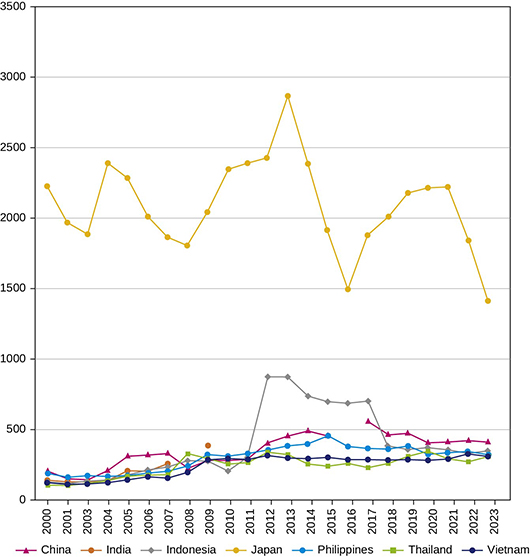
Figure 1 Global rice producer prices, 2000–23, in USD per tonne of paddy
Source: FAOSTAT (2025).
Policy Implications
Right Approach
The above analysis shows that despite the key role of rice, income from rice for most farmers in Asia remains low. The rice sector in Asia is also facing enormous challenges due to climate change and industrialisation and urbanisation. Different approaches can be taken to develop the rice sector in the region: land and other resources can be diverted from rice to other higher income-generating activities or more efforts can be made to boost rice farmers’ income. The first approach is risky for both net rice-importing and net rice-exporting countries as it concerns the livelihoods of a substantial portion of the population and could undermine food security, which is the foundation for social stability, especially for countries with large populations.
Rice net exporting countries on the other hand have some room to manoeuvre. However, allowing the rice sector to remain stagnant or to even shrink, by conversion of land under rice with the best soil quality, equipped with irrigation facilities, must be carefully considered. Non-farm activities can be limited to non-farm land or land least suitable for farming. The increasing negative impact of climate change on agriculture must be taken into consideration not just for the present but also for future generations.
Countries need industrialisation and urbanisation to be prosperous, but this should not come at the cost of the core food sector. All nations must continuously develop the rice sector to ensure national food security, improve the livelihood of rice farmers, making it more resilient. In this process, maintaining the incentive for farmers by further improving their income is the most important aspect.
One way in which many governments support farmers is by giving subsidies (on seeds, chemical fertilizers, water, machinery, purchasing prices). Others do so by investing more in the development and transfer of technologies, irrigation, and other rural infrastructure and services. While some short-term subsidies may be necessary, the first approach may not be sustainable, and may, at times, constrain the achievement of more long-term targets. Subsidising the costs of chemical fertilizers or water contradicts efforts to increase their use efficiency and reduce emission from rice farming. Such policies are even more questionable for rice exporting countries.
The rice sector’s development should be mostly science-driven, farmer-centric, economically effective, equitable, and environment-friendly.
Application of Highly Effective New Rice Farming Technologies
To address goals regarding the development of the rice sector, win-win technologies can and must be developed. In Viet Nam, as well as some other countries, farmers are overusing seeds, fertilizers, water, and pesticides. In 2023, the Government of Viet Nam adopted the programme of “Sustainable Development of One Million Hectares of High Quality, Low Emission Rice in Conjunction with Green Growth in the Mekong Delta by 2030” (CGIAR 2023). To support the programme, the International Rice Research Institute, in cooperation with Vietnamese national research centres, developed a technical package which was formally adopted and embedded into a manual of technical guidelines by the Ministry of Agriculture and Rural Development for implementation in the programme areas.
The manual includes three components of rice production: i) cultivation techniques; ii) harvest and post-harvest management; and iii) straw management. The main techniques introduced are: application of new high-yielding, high-quality rice varieties; synchronised mechanisation of land preparation with land levelling; alternate wetting and drying water management (AWD); mechanised seeding with deep placement of fertilizers; judicious crop need–based application of fertilizers; integrated pest management; in-time harvesting; application of modern technology for harvesting, drying, storage, transportation (to preserve energy and reduce losses); and straw management following the principles of circular economy (to reduce burning and improve soil health, and increase farmer income) (Department of Crop Production 2024).
Reports from pilot demonstrations showed that the application of this technical package resulted in reducing the quantity of seeds, chemical fertilizers, pesticide spray, water (via AWD), while increasing yield and farmer profit and reducing emissions, in comparison to current practices.
Development of Sustainable Irrigation and Other Rural Infrastructure and Services
Stable and productive rice farming requires irrigation. Irrigation plays an even bigger role as the effects of climate change become evident. A suitable irrigation system is also necessary to allow farmers to apply AWD. It requires not only more investment but also better management. Appropriate water policies should be applied to motivate farmers to invest in and protect irrigation systems, and use water economically.
Besides irrigation, roads, electric supply, and internet also need to be upgraded. The use of drones, remote sensing, AI, and other digital technologies cannot progress without internet connectivity in rice fields.
Policy Reform
Enabling policy settings should allow farmers to reap maximum benefits, encouraging them and businesses to make long-term investments in the rice sector. Priority assistance should be provided to small-sized rice farming households.
Land policy is the prime agricultural policy – it is also always one of the most politically sensitive policies. It needs to address various critical issues at once: (i) ensuring landless farmers have fair and cheap access to land; (ii) ensuring commercial rice farmers have easy access to land; and (iii) protecting both the quantity and quality of land for rice.
There is an increasing need for land consolidation for larger-scale farming. This process should be accommodated. There is also a great demand for conversion of rice land for non-farm as well as other agricultural purposes. Uncontrolled conversion of rice land may endanger food security in Asian countries and in the region as well as globally.
A strong rice production promotion package is needed. An enabling financial system should be available to assist all participants in the rice value chain. Credit policy can have a noticeable impact on rice farmers’ income (Nhien et al. 2020; Ngọc and Kiệt 2019). A transparent trade policy regarding both inputs and rice is important to create the right incentives for stakeholders in the rice sector.
Conclusion and Discussion
Rice is an important commodity for Asia. The rice sector is a crucial part of national economies and forms the core of food systems in the region. Ensuring sufficient domestic rice supply is advised for most countries, especially populous ones. Rice farming and related activities are also important sources of employment and income for hundreds of millions of people. The development of the rice sector not only ensures food security but also improves farmers’ income and livelihood while protecting the environment and contributing to sustainable national development. However, the relative share of income from rice in most national economies and the income of most rice farmers is moderate and varies. Improvement of farmers’ income is necessary to maintain incentives for further development of the rice sector. An initiative-led approach, enabling market-oriented policy, advanced win-win resilient technologies, improved infrastructure, and support services would help stabilise and significantly increase farmers’ income, as well as national income from rice.
Notes
1

References
| Bangladesh Rice Knowledge Bank (2025), “Rice in Bangladesh,” available at
| |
| Can Tho City Department of Agriculture and Rural Development (2023), Report: Results of Survey on Expenses and Costs of Winter – Spring 2022 – 2023 Rice, May 5.
| |
| CGIAR (2023), “Vietnam Launches the One Million Hectares Program Specializing in High-quality, Low-emission Rice Production,” available at https://www.cgiar.org/news-events/news/vietnam-launches-the-one-million-hectares-program-specializing-in-high-quality-low-emission-rice-production, viewed on May 5, 2026.
| |
| China Global Television Network (2020), “22.5 Tons Per Hectare! China’s Hybrid Rice Yield Breaks Record,” available at https://news.cgtn.com/news/2020-11-02/22-5-tonnes-per-hectare-China-s-hybridrice-yield-breaks-record-V5XHhym3Uk/index.html, viewed on August 20, 2025.
| |
| Department of Crop Production (2024), “Hand-on Manual: Technical Guidelines for High Quality and Low Emission Rice Production in the Mekong Delta,” Ministry of Agriculture and Rural Development, Hanoi, Viet Nam, available at https://cgspace.cgiar.org/items/fa1c80b9-b4e4-4b94-9625-cadc918a9cf5, viewed on Aug 28, 2025.
| |
| Dong, Qiu, and Wang, Huaiyu (2025), “Comparison of Cost and Benefit in Rice Production Between Farmer Economies in Japan and China,” Erina Report no. 6 2025, available at https://www.unii.ac.jp/erina-unp/wp-content/uploads/sites/5/2025/05/ERINAREPORT6-81.pdf , viewed on Aug 19, 2025.
| |
| Fahmid, Imam Mujahidin, Jamil, Ali, Wahyudi, Agustian, Adang, Hatta, Muhammad, Aldillah, Rizma, Yofa, Rangga Ditya, Sumedi, Sumaryanto, and Susilowati, Sri Hery (2022), “Study of the Impact of Increasing the Highest Retail Price of Subsidized Fertilizer on Rice Production in Indonesia,” Open Agriculture, vol. 20227, no. 1, pp. 348–59, available at DOI:
| |
| FAOSTAT (2025), “Food and Agriculture Data,” available at https://www.fao.org/faostat/en/#home, viewed on July 10, 2025.
| |
| General Statistics Office of Vietnam (GSO) (2018), Results of the Rural, Agricultural and Fishery Census 2016, Statistical Publishing House, available at https://www.nso.gov.vn/wp-content/uploads/2019/03/TDT-NTNNTS-2016-1.pdf, viewed on July 10, 2025.
| |
| Shen, Xue, Yang, Quanyu, Ao, Rongjun, and Shengsheng, Gong (2024), “Rural Labor Migration and Farmers’ Arrangements of Rice Production Systems in Central China: Insight From the Intergenerational Division of Labor,” Journal of Integrative Agriculture, vol. 23, no. 9, pp. 3200–14, available at https://www.sciencedirect.com/science/article/pii/S2095311924002855, viewed on March 15, 2026.
| |
| GSO (2024), Statistical Yearbook 2023, available at https://www.nso.gov.vn/, viewed on July 10, 2025.
| |
| Khan, Halema (2020), “Economic Analysis of Boro Rice Cultivation of Burichang Upazilla of Cumilla District in Bangladesh,” MS thesis, Department of Agricultural Statistics, Sher-E-Bangla Agricultural University, Dhaka, available at https://saulibrary.edu.bd/daatj/public/uploads/13-05510.pdf, viewed on August 21, 2025.
| |
| Latt, Aye New, Myint, Theingi, Aye, Myo Sabai, and Htwe, Nyein (2025), “Profitability of Different Rice Varieties for Domestic and Export Markets: Case Study in Nay Pyi Taw Union Territory, Myanmar,” FFTG Agricultural Policy Platform, available at https://ap.fftc.org.tw/article/3792, viewed on August 21, 2025.
| |
| Masuda, Kiyotaka (2017), “Energy Efficiency of Intensive Rice Production in Japan: An Application of Data Envelopment Analysis,” Sustainability, vol. 10, no. 1, p. 120, available at https://doi.org/10.3390/su10010120, viewed on August 21, 2025.
| |
| Mesa (2025), “Philippine Agriculture Transformation: Experiences and Reform Agenda,” available at https://cgspace.cgiar.org/server/api/core/bitstreams/be11fec7-194a-4ee6-8588-7d4343362003/content, viewed on February 22, 2026.
| |
| Ministry of Agriculture, Forestry and Fisheries of Japan (MAFF) (2020), 96th Statistical Yearbook of the Ministry of Agriculture, Forestry and Fisheries of Japan, available at https://www.maff.go.jp/e/data/stat/96th/index.html, viewed on Aug 17, 2025.
| |
| Mishra, A. K., Pede, V. O., Arouna, A., Labarta, R., Andrade, R., Veettil, P. C., Bhandari, H., Laborte, A. G., Balie, J., and Bouman, B. (2022), “Helping Feed the World with Rice Innovations: CGIAR Research Adoption and Socioeconomic Impact on Farmers,” Global Food Security, vol. 33, article no. 100628, available at https://www.sciencedirect.com/science/article/pii/S2211912422000190, viewed on August 19, 2025.
| |
| Ngọc, Tô Thị Bích, and Kiệt, Nguyễn Tuấn (2019), “Tác động của tín dụng chính thức đến thu nhập trồng lúa của nông hộ: Bằng chứng thực nghiệm tại Cần Thơ” [“Impact of the Formal Credit on Income of Rice Farm Households: Evidence from Pilots in Can Tho City”], Journal of Science, vol. 55, pp. 115–26, available at https://ctujsvn.ctu.edu.vn/index.php/ctujsvn/article/view/3463, viewed on Jul 10, 2025.
| |
| Nhien, Pham Thi, Linh, Nguyen Duyen, Thuyen, Pham Thi, and Cuong, Nguyen Van (2020), “Tac dong cua von tin dung den thu nhap cua nong ho trong lua tren dia ban huyen Chau Thanh tinh Tay Ninh” [“Impact of Credit on Rice Farmers Income in Chau Thanh District, Tây Ninh Province”], Journal of Forestry Science and Technology, vol. 3, pp. 137–45, available at https://journal.vnuf.edu.vn/vi/article/view/641, viewed on July 10, 2025.
| |
| Orge, Ricardo F., Pascual, Kristine S., Beltran, Jesusa C., Juganas, Tyrone C., Martin, Rachelle Marie S., and Corales, Aurora M. (2022), “Rice Mechanization Models for Smallholder Farmers: A Case in the Philippines,” Rice – Based Biosystems Journal, vol. 10, pp. 33–40, available at https://www.researchgate.net/publication/362348952_Rice_mechanization_models_for_smallholder_farmers:_A_case_in_the_Philippines, viewed on Aug 5, 2025.
| |
| Philippine Statistics Authority (PSA) (2023), “2022 Costs and Returns of Palay Production,” available at https://psa.gov.ph/system/files/main-publication/Full%20Report%2C%202022%20SCR%20of%20Palay%20Production_signed.pdf, viewed on August 12, 2025.
| |
| Pochanasomboon, Amorn, Attavanich, Witsanu, and Kidsom, Akaranant (2020), “Impacts of Land Ownership on the Economic Performance and Viability of Rice Farming in Thailand,” Land, vol. 9, no. 3, p. 71, available at https://doi.org/10.3390/land9030071, viewed on August 6, 2025.
| |
| Pongsrihadulchai, Apichart (2018), “Thailand’s Rice Industry and Current Policies Toward High Value Rice Products,” FFTC Agricultural Platform, available at https://ap.fftc.org.tw/article/1297, viewed on August 5, 2025.
| |
| Sayeed, Khan Ahmed, and Yunus, Murshid Mohammad (2018), “Rice Prices and Growth, and Poverty Reduction in Bangladesh,” Food and Agriculture Organisation (FAO) paper, available at https://openknowledge.fao.org/server/api/core/bitstreams/613ea845-eab1-4e7f-bab8-a53b3874eb90/content, viewed on August 21, 2025.
| |
| Tinde, Lokesh Kumar, Porte, Devendra Singh, Parmar, Kshitij, Barle, Rajni, Singh, P. R., Kumar, Dilip, and Kaushik, Jyoti (2022), “Economic Analysis of Rice Crop Under Three Categories of Farm Holders at the Time of Covid-19 Pandemic,” Flora and Fauna, vol. 28, no. 1, pp. 2126, available at https://floraandfona.org.in/Uploaded%20Pdf/281/21-26.pdf, viewed on Aug 17, 2025.
| |
| Topphak, P., Khermkhan, J., and Suwanmaneepong, S. (2023), “Comparison of Cost and Return Between Paddy Production and Rice Seeds Production of Ban Na Ngam Rice Mill Community Enterprise in Chachoengsao Province of Thailand,” International Journal of Agricultural Technology, vol. 19, no. 4, pp. 1929–38, available at http://www.ijataatsea.com/pdf/v19_n4_2023_July/38_IJAT_19(4)_2023_Topphak,%20P.(55).pdf , viewed on Aug 9, 2025.
| |
| United Nations Development Programme (2023), Strengthening Food Security in Myanmar: A Roadmap for Localized Action, Myanmar Development Observatory, available at https://www.undp.org/asia-pacific/publications/strengthening-food-security-myanmar-roadmap-localized-action, viewed on February 22, 2026.
| |
| United States Department of Agriculture Global Agricultural Information Network (USDA GAIN) (2020), “Expansion of Support Payments for Rice and New 2021 Rice Production Targets: Country: Japan,” available at https://www.maff.go.jp/e/data/stat/96th/index.html, viewed on August 17, 2025.
| |
| Utami, Anisa Dwi, and Harianto (2021), “Farmers’ Subsistence in Indonesia Rice Farming,” Journal of Indonesian Agribusiness, vol. 9, no. 2, pp. 79–87, available at https://doi.org/10.29244/jai.2021.9.2.79-87, viewed on March 15, 2026.
| |
| Widyanto, Septian, and Subanu, Leksono Probo (2023), “The Factors of Rice Farmers’ Poverty in Indonesia: The Perspective of Land Conversion, Land Ownership Area, and Agriculture Technology,” Jurnal Kawistara: The Journal of Social Sciences and Humanities, vol. 13, no. 1, p. 121, available at DOI:
| |
| World Bank (2025), “Reinventing Rice as Countries Cultivate Change: Four Countries Where Rice Is Grown Differently,” available at https://www.worldbank.org/en/news/feature/2025/06/09/reinventing-rice-as-countries-cultivate-change, viewed on March 15, 2026.
| |
| World Bank and Australian Aid (2022), “From the Last Mile to the Next Mile, 2022 Vietnam Poverty and Equity Assessment,” available at https://documents1.worldbank.org/curated/en/099945004182217194/pdf/P17626100f8c0005d0b7270db2c28481e36.pdf, viewed on March 15, 2026.
|
Appendix
Appendix Table 1 Rice production and share in total for Asian countries, 2023 in million tonnes and per cent
| Country | Production (million tonnes) | Share in total (per cent) |
| China mainland | 206.6 | 28.8 |
| India | 206.7 | 28.8 |
| Bangladesh | 58.6 | 8.2 |
| Indonesia | 54.0 | 7.5 |
| Viet Nam | 43.5 | 6.1 |
| Thailand | 33.1 | 4.6 |
| Myanmar | 25.6 | 3.6 |
| Philippines | 20.1 | 2.8 |
Source: FAOSTAT (2025).
Date of submission of manuscript: March 7, 2026
Date of acceptance for publication: May 25, 2026