

CURRENT ISSUE
Vol. 16, No. 2
JULY-DECEMBER, 2026
Land, Labour, and State: Revisiting Manipur’s Agrarian Past
Haokholal Kipgen*
*PhD candidate, Department of History, University of Hyderabad, amosboilal@gmail.com
| Basanta, Ningombam (2023), Agrarian System of Manipur, 1826–1947 A. D., Sunmarg Publishers & Distributors, New Delhi, pp. viii, 149. |
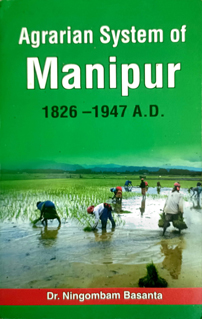 |
Dr. Ningombam Basanta’s Agrarian System of Manipur (1826–1947 A.D.) is a detailed regional study that examines the historical evolution of agrarian relations in Manipur, a State in northeast India, across the late pre-colonial and colonial periods. Situated at the intersection of environmental history and agrarian political economy, the book seeks to explain how a geographically constrained region developed a functioning agrarian system and how this system was reshaped – though not fundamentally transformed – under British rule. The central argument advanced by Basanta is that agrarian structures in Manipur were historically rooted in indigenous systems of ecological management and political authority, and that colonial intervention primarily reconfigured rather than replaced these structures.
The book opens with an environmental framing that foregrounds the ecological constraints of the Imphal valley. Basanta notes that the Imphal valley or Manipur valley was once covered by marshy land that was unfit for cultivation (p. vii), thereby emphasising that agrarian development was a product of deliberate human intervention. The introductory chapter situates agriculture within the valley–hill divide, where wet rice cultivation in the valley contrasted with shifting (jhum) and terrace cultivation in the hills. This ecological grounding is one of the book’s key contributions, as it highlights the importance of environmental adaptation and indigenous knowledge systems. Farmers’ reliance on natural indicators for rainfall prediction and water management reflects a sophisticated understanding of local ecosystems. Subsequent chapters deal with the role of political authority in agrarian development. Basanta traces the emergence of the Manipuri polity from clan-based structures to a centralised monarchy, arguing that state formation was closely tied to agricultural expansion. Rulers are portrayed as active agents in land reclamation, irrigation, and the organisation of production. The development of drainage systems and the clearing of marshland are presented as state-led initiatives that enabled the expansion of wet rice cultivation. This argument is extended in the discussion of royal granaries (kei), which functioned as mechanisms of redistribution during periods of scarcity. Such evidence suggests that the pre-colonial state played a significant role in stabilising the agrarian economy. However, the treatment of state power tends towards a functionalist interpretation that underplays coercion and social differentiation. While the book convincingly demonstrates the importance of political authority in agricultural development, it does not sufficiently interrogate the conditions under which labour was mobilised or the extent to which state policies imposed burdens on cultivators. This limits the analytical depth of the discussion, particularly in relation to debates in agrarian political economy.
The most analytically substantive section of the book is the chapter on land ownership. Basanta identifies land as the central axis of agrarian relations and examines the transition from pre-colonial to colonial land tenure systems. Traditionally, land was vested in the ruler, with cultivators holding usage rights. The introduction of the patta system under British administration formalised these rights by granting occupancy, inheritance, and transfer privileges, albeit conditional on revenue payments. Despite this apparent shift, Basanta argues that the underlying structure of land ownership remained largely unchanged. A significant proportion of land continued to be controlled by elites, who leased it to actual cultivators, thereby reinforcing hierarchical relations. This argument aligns with broader scholarship on colonial agrarian regimes, which emphasises the persistence of pre-existing social structures under colonial rule. Yet the book stops short of engaging explicitly with these debates. Concepts such as feudalism, semi-feudalism, or capitalist transition are not addressed systematically. A more explicit engagement with comparative frameworks, particularly studies of agrarian change in other parts of South Asia would have strengthened the analytical contribution.
The chapters on peasant life and agricultural practices provide a detailed account of the material conditions of rural society. Basanta describes cultivation techniques, tools, and seasonal cycles with considerable precision, highlighting the labour-intensive nature of wet rice agriculture. The discussion of local technologies, including water mills and transplantation methods, highlight the adaptive capacity of the agrarian system. At the same time, the analysis of subsistence patterns reveals the limitations of the pre-colonial economy, particularly its inability to generate surplus for external trade. Colonial intervention altered this dynamic by integrating Manipur into wider markets. The construction of roads facilitated the export of rice, transforming it into a commercial crop. While this development created new economic opportunities, it also exposed peasants to market fluctuations and increased their economic vulnerability. Basanta’s account of floods and famines, particularly during the period of direct British administration (1891–1907), highlights the ecological and administrative failures of colonial governance. These crises underscore the fragility of the agrarian system under changing political conditions.
The final substantive chapter examines community life and social organisation. Basanta emphasises the collective nature of agrarian production, including shared resources and cooperative labour arrangements. Institutions such as communal forests and village-level cooperation played a crucial role in sustaining the agrarian economy. However, colonial administrative changes disrupted these systems. The introduction of new officials, such as the chaukidar, undermined traditional authorities such as the khullakpa (village headman), and led to a decline in local autonomy. This shift reflects a broader transformation from community-based governance to centralised control.
Despite its empirical richness, Agrarian System of Manipur (1826–1947 A. D.) has several limitations that become apparent when the evidence in the book is considered in relation to agrarian power, social hierarchy, and unequal access to productive resources. The first is the book’s predominantly descriptive approach. Basanta reconstructs agricultural practices, landholding categories, revenue arrangements, peasant life, and community institutions in considerable detail, but he does not always explore the relations of power embedded in these institutions (even though the book itself provides evidence of unequal access to land and differentiated claims over agricultural produce). Before the introduction of the patta system, the Raja (king), royal relatives, Brahmans, officials, and other privileged groups controlled substantial categories of land, while cultivators could work land without secure possession. Basanta notes that poor peasants cultivated the land of rich persons and that the Raja could transfer land from one cultivator to another. The patta system later gave cultivators occupancy, inheritance, and transfer rights subject to revenue payment, but the concentration of land in the hands of Rajkumars (i.e. the ruler and his relatives), Brahmans, and high officials continued. The book needs a deeper and more sustained analysis of agrarian inequality.
The question of caste is particularly important in assessing this limitation. Basanta does not present Manipur as a caste-based agrarian society comparable to many regions of mainland India. In his discussion of community life, he states that society was not generally caste-ridden, while noting that Brahmans enjoyed certain privileges in religious matters. He further observes that Brahmans did not work in fields and homesteads, and that other sections of the village carried out such work (pp. 140–41). This evidence suggests that caste did exist as a socially consequential category, although agrarian production was not organised in the same way as in agrarian regions elsewhere. Being a Brahman could exempt one from agricultural labour and gave access to particular land grants such as Brahmangi Lou, which was associated with ritual service to the state and society (p. 95). The book, however, does not systematically investigate how caste status affected access to land, agricultural labour, tenancy, or the distribution of surplus.
This then raises the related question of whether extra-economic pressures operated in such an agrarian society. Here, the book provides suggestive evidence, although it does not itself formulate the issue in these terms. The pre-colonial agrarian order was embedded in political authority, service obligations, privileged land grants, and forms of compulsory labour. In this context, the institution of lallup, or forced labour, is especially significant. Basanta notes that lallup was abolished in 1892, when it was replaced by a house tax. Similarly, a cultivator holding land under a pattadar could pay them grain rent. The book also describes land categories associated with royal family members, Brahmans, soldiers, officials, and those involved in other forms of service. These arrangements point to extra-economic pressures based on political status, institutional position, and customary obligation. While they cannot automatically be equated with caste oppression, these arrangements negate the picture of a purely egalitarian or caste-free agrarian society. One of the book’s limitations is that it does not bring these different forms of power together within a common analytical framework.
Another limitation of the book is that it tends to treat the peasantry as a homogeneous group, without sufficiently investigating the differences among cultivators in terms of landholding, tenancy, and access to resources. The evidence presented by Basanta suggests that peasants occupied different agrarian positions and did not share identical rights, obligations, or economic interests. For instance, following the introduction of the patta system, a distinction emerged between pattadars who held land directly from the state and cultivators who worked land under pattadars and paid rent in grain. Earlier land arrangements also distinguished among royal, service, military, Brahman, and other categories of land, each potentially involving different rights and obligations. These differences shaped cultivators’ security of tenure, their relationship with authority, and their ability to retain agricultural surplus. By treating these diverse groups under the general category of “peasants,” the book does not fully explore the internal inequalities within the agrarian society or the possibility that cultivators had different, and sometimes competing, interests. A more detailed analysis could have examined how colonial land settlements reshaped these existing distinctions, whether they created new forms of agrarian differentiation, and to what extent they reproduced or reinforced pre-existing inequalities rather than eliminating them.
Gender is another underdeveloped dimension of the book. The book contains references to women’s participation in agricultural and ritual life, but it is not a sustained analytical category. The discussion does not analyse the gender division of labour, gender differences with regard to the control of agricultural produce and property, or how women participated in household and village institutions.
Basanta recognises the distinction between wet rice cultivation in the valley and jhum and terrace cultivation in the hills, but the analysis is weighted towards the valley and its state-centred institutions. A more systematic comparison could have shown whether landholding, labour obligations, customary authority, and commercialisation operated differently in the hill areas.
Finally, the book would have benefited from a stronger engagement with wider agrarian historiography. The evidence it presents on land, tenancy, rent, forced labour, commercialisation, and colonial revenue provides a basis for discussing agrarian class formation, feudal or semi-feudal relations, and Manipur’s incorporation into a colonial market economy. Yet these theoretical implications remain largely implicit. The central argument that British rule reconfigured rather than fundamentally transformed existing agrarian structures is important, but asking more explicitly who benefited from these changes, who remained vulnerable, and how the balance between political authority and market relations shifted over time, would have strengthened this argument about continuity and change.
In conclusion, Agrarian System of Manipur is an empirically valuable regional study of the relationship between ecology, political authority, land, labour, and agricultural production. Basanta’s discussion of marshland reclamation, water management, indigenous agricultural knowledge, landholding, peasant life, community institutions, and the commercialisation of rice provides important material for understanding Manipur’s agrarian past. His argument that British rule modified existing arrangements without simply replacing them is supported by the persistence of older forms of landholding and social authority alongside new revenue and market institutions.
The book also raises important questions about the social relations underlying agrarian production. The evidence it presents on privileged landholding, grain rent, lallup, land grants to Brahmans, and unequal access to land suggests that agrarian power operated through several institutions rather than through caste alone. The limited treatment of caste is therefore significant precisely because the book contains evidence of status-based privilege without presenting caste as the principal organising structure of agriculture. Further research could examine these relationships alongside gender, class differentiation, customary authority, and the valley–hill divide. Such a comparative and theoretically informed approach would extend the empirical foundation laid by Basanta and deepen our understanding of how agrarian systems changed in Manipur while retaining important elements of earlier political and social arrangements.