
Making the Colonial Archive Public: A Review of the Dufferin Report
Madhavi Jha*
*Assistant Professor, Department of Humanities and Social Sciences, Birla Institute of Technology and Science, Pilani, madhavi.jha@hyderabad.bits-pilani.ac.in
| Moosvi, Shireen (ed.) (2023), Agrarian Inequalities in Colonial Uttar Pradesh: The Dufferin Inquiry, 1887–88, Primus Books, pp. 290. |
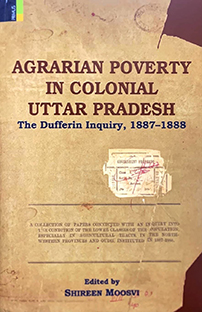 |
At the time of writing this review, a range of controversies surround statistical knowledge-making in contemporary India – from what it means to be part of the electorate of this country (Mishra 2025), to the delayed 2021 decennial census and enumeration of caste data (Kumar, Mohanan, and Kundu 2020; Deshpande 2025; Lakshman 2025). Within the discipline of history, statistical data’s utility as an archive have been viewed from varying perspectives. Within the extremes of complete trust in datasets found in historical documents, to their resolute disregard, a number of productive questions have been asked of such archives (Cohn 1990; Appadurai 1993; Guha 2003; Kalpagam 2014; Fuller 2016). The publication of Agrarian Poverty in Colonial Uttar Pradesh. The Dufferin Inquiry, 1887-1888 [henceforth the Dufferin Report], in book form edited by Shireen Moosvi provides us with an opportunity to continue asking nuanced questions of the colonial economy and society, particularly in the context of the State of Uttar Pradesh. The report itself, copies of which can be accessed from different archives including the National Archives of India (New Delhi), is a well-known document amongst the social and economic historians of South Asia. However, it is for the first time that the report (parts pertaining to the North Western Provinces [NWP], or roughly present-day Uttar Pradesh) has become available in a book form. The Dufferin Report is prefaced by an introduction and four annexures1 written by the author.
The introduction takes us through the process of how this document came to be – from the village informants of various districts of the province, to the extant archiving and publication politics. The inquiry process was a result of the British Indian government’s attempts to put to rest the criticisms of its ability to rule the country. The preceding two decades had seen devastating famines and scarcities in different parts of the country, drawing international censure, British parliamentary scrutiny, and Indian nationalist ire (Haggis and Allen 2008; Brewis 2010; Twomey 2012; Simonow 2022). The latter linked the recurrent famines to deindustrialisation, and drain of wealth to construct their economic critique of colonialism (Goswami 2004; Chandra 2018; Karak 2021; Patel 2024). The driving question for the Dufferin inquiry was to ascertain if the majority of Indians were insufficiently fed. While the consequent survey was meant to counter this accusation, the results of the survey were damning enough to render the report sensitive in the eyes of the colonial administration. When the report eventually reached the British parliament in 1903, the worth of the expense of publication in its entirety was questioned (UK Parliament 1903). However, as Moosvi relates, the various provinces published the parts of the report that were relevant to them – in the case of the NWP, the report was printed at the Government of India Press, Nainital (see page xiv to xv of the “Introduction”). The enquiry was considered sensitive as it exposed the very bleak situation of the “average” Indian’s life that it was meant to refute. This despite the fact that the enthusiasm and method of data collection varied vastly between the different districts. For instance, while the ethnographer-administrator William Crooke went about the task with his usual diligence as the Collector of Etah (Amin 1994), there were others who were either hard pressed for time, or did not see the value of such an inquiry.
Moosvi takes into account these variations and hence employs a case study approach in the four annexures that draw attention to income inequality, rent and revenue, indebtedness, and gender and work respectively. The selected case studies (the recorded response to the specific enquiry questions) are presented from the different districts of NWP. While the choice of the case study is certainly dependent on the theme that a particular annexure addresses, the responses themselves are presented more or less verbatim. The data presented in these case studies are accented by Moosvi to mark their significance or consequence within the broader scheme of the annexure. Some broad conclusions drawn by Moosvi in these sections merit repetition. A reading of the archive on rent and revenue from select districts refutes the widely held belief that peasantry’s indebtedness resulted from expenses on rituals or festivals. The data demonstrates that not only was rent the heaviest burden for the ordinary peasants, institutional assistance in the form of revenue remissions or taccavi loans were rare. The rural moneylender was then a central figure in rural areas. Given the high rates of interest, moneylending was a profitable business and was not confined to the traditional moneylending castes. The report confirms that often the landlords and moneylenders were the same person, making it difficult for peasants to escape the cycle of usury. The figures on household income and expenditure relate an unsurprising story of poverty and inequality. The clinical language of the reports is unable to hide the experience of poverty in rural Uttar Pradesh in late 19th century. So, we read about the woman whose one piece of clothing doubled up as her “quilt” during winter nights, of the family whose frequency of daily meals fluctuated with the availability of wage labour, of married individuals unable to lead a conjugal life due to severe economic hardship, and so on. Like in other parts of India, in rural Uttar Pradesh, women’s labour was dependent on their caste and class location, as well as their marital status. During the period covered in this report, women contributed significantly to household resources, either through wages or labour.
The editor is also careful to draw the reader’s attention to plausible errors in the reported statistics. This attention to detail does not come as a surprise since the author is well-known for her statistical analysis of Mughal history (Moosvi 2011, 2015b). Her scholarly venture into a succeeding time period is driven by similar interests in the questions of class, labour, and inequality. Understandably then, it is in the context of the colonial political economy that these questions are posed. It is also heartening to see an entire annexure dedicated to gender and work, an oft-neglected area in economic and labour history.
The nationalist critique of British colonial policies and the theories of the drain of wealth from India constitute a body of writing that provided the intellectual grounding for the national movement. In recent years, this has attracted new discussion, including from those who question the basis of the theories (Ray 2016). A summary of the debate – even in an extended footnote – would have been welcome, especially for younger scholars.
The book is a necessary reminder of the need to critically study historical statistical enquiries which will only help us augment our knowledge of rural India, an area which has seen a recent upsurge in historical research in South Asia.2
In conclusion, one can reflect on the implications of holding an archival document in one’s hand—being able to look up a reference, or take it to class or lecture. Making archival material available to all has been a constant challenge within the discipline of history. It is not just a matter of portability, but also of democratising access to knowledge production. The ties and tensions of public histories and academic histories, the digitisation of government and non-government archives, and the digital archiving practices have all contributed to the demystification of the colonial document as a privileged archival artefact. The publication of the Dufferin Report represents another step forward in this direction.
Notes
1 Versions of the annexures have been published earlier in different journals – see Moosvi (2015a, 2016, 2019, 2020).

2 Examples include Bhattacharya (2019) and Gill (2024).
References
| Amin, S. (1994), “Cataloguing the Countryside: Agricultural Glossaries From Colonial India,” History and Anthropology, vol. 8, no. 1–4, pp. 35–53.
| |
| Appadurai, Arjun (1993), “Number in the Colonial Imagination,” in van der Veer, Peter and Breckenridge, Carol (eds.), Orientalism and the Post-Colonial Predicament, University of Pennsylvania Press, Philadelphia.
| |
| Bhattacharya, Neeladri (2019), The Great Agrarian Conquest: The Colonial Reshaping of a Rural World, SUNY Press.
| |
| Brewis, Georgina (2010), “‘Fill Full the Mouth of Famine’: Voluntary Action in Famine Relief in India 1896–1901,” Modern Asian Studies, vol. 44, no. 4, pp. 887–918.
| |
| Chandra, Bipan (2018), The Rise and Growth of Economic Nationalism in India: Economic Policies of Indian National Leadership, 1880–1905, People’s Publishing House, New Delhi.
| |
| Cohn, Bernard (1990), “The Census, Social Structure and Objectification in South Asia,” in An Anthropologist Among the Historians and Other Essays, Oxford University Press, Oxford.
| |
| Deshpande, Satish (2025), “Caste Census in a Fraught Political Moment: Selfie of the Nation,” Indian Express, Jun 16, 2025, available at https://indianexpress.com/article/opinion/columns/caste-census-in-a-fraught-political-moment-selfie-of-the-nation-10068835/, viewed on December 1, 2025.
| |
| Fuller, C. J. (2016), “Anthropologists and Viceroys: Colonial Knowledge and Policy Making in India, 1871–1911,” Modern Asian Studies, vol. 50, no. 1, pp. 217–58.
| |
| Gill, Navyug (2024), Labors of Division: Global Capitalism and the Emergence of the Peasant in Colonial Panjab, Stanford University Press.
| |
| Goswami, Manu (2004), Producing India: From Colonial Economy to National Space, University of Chicago Press.
| |
| Guha, Sumit (2003), “The Politics of Identity and Enumeration in India C. 1600–1990,” Comparative Studies in Society and History, vol. 45, no. 1, pp. 148–67.
| |
| Haggis, Jane, and Allen, Margaret (2008), “Imperial Emotions: Affective Communities of Mission in British Protestant Women’s Missionary Publications C1880–1920,” Journal of Social History, vol. 41, no. 3, pp. 691–716.
| |
| Kalpagam, Umamaheswaran (2014), Rule by Numbers: Governmentality in Colonial India, Bloomsbury Publishing PLC.
| |
| Karak, A. (2021), “What Was ‘Indian’ Political Economy? On the Separation of the ‘Social’, the ‘Economic’, and the ‘Ethical’ in Indian Nationalist Thought, 1892–1948,” Modern Asian Studies, vol. 55, no. 1, pp. 75–115.
| |
| Kumar, Arjun, Mohanan, P. C., and Kundu, Amitabh (2020), “Disastrous Decade for Data: The Way Forward,” Economic and Political Weekly, vol. 55, no. 41, Oct 10, 2020, available at https://www.epw.in/journal/2020/41/commentary/disastrous-decade-data.html, viewed on Dec 1, 2025.
| |
| Lakshman, Abhinay (2025), “India Well-placed to Conduct Caste Census, Says Prof. Sukhdeo Thorat,” The Hindu, May 6, 2025, available at https://www.thehindu.com/news/national/india-well-placed-to-conduct-caste-census-says-prof-sukhdeo-thorat/article69545208.ece, viewed on December 1, 2025.
| |
| Mishra, Soni (2025), “SIR 2.0: Bihar’s Shadow Spreads,” Frontline, Oct 30, 2025, available at https://frontline.thehindu.com/politics/eci-special-intensive-revision-12-states-political-row/article70220110.ece, viewed on December 1, 2025.
| |
| Moosvi, Shireen (2011), “The World of Labour in Mughal India (C. 1500–1750),” International Review of Social History, vol. 56, no. S19, pp. 245–61.
| |
| Moosvi, Shireen (2015a), “Agrarian Inequalities in Colonial UP: The Dufferin Inquiry, 1887–88,” Social Scientist, vol. 43, no. 1/2, pp. 9–21.
| |
| Moosvi, Shireen (2015b), The Economy of the Mughal Empire C. 1595: A Statistical Study, Oxford University Press.
| |
| Moosvi, Shireen (2016), “Rent and Poverty in Western Uttar Pradesh: The Official Inquiry of 1888–89,” Studies in People’s History, vol. 3, no. 2, pp. 197–215.
| |
| Moosvi, Shireen (2019), “The Rural Moneylender, 1888: The Dufferin Report for West UP,” Studies in People’s History, vol. 6, no. 2, pp. 170–75.
| |
| Moosvi, Shireen (2020), “Women, Poverty and Work in Colonial Rural India: The Dufferin Inquiry, 1887–88,” Studies in People’s History, vol. 7, no. 2, pp. 171–79.
| |
| Patel, D. (2024), “To Revive India’s Industries: The Global and Imperial Roots of Swadeshi in the Nineteenth Century,” Modern Asian Studies, vol. 58, no. 3, pp. 686–711.
| |
| Ray, Indrajit (2016), “The Myth and Reality of Deindustrialization in Early Modern India,” in Chaudhary, Latika et al. (eds.), A New Economic History of Colonial India, Routledge, Abingdon, pp. 52–66.
| |
| Simonow, Joanna (2022), “American Humanitarianism in Colonial South Asia: The Famine Relief of the American Marathi Mission in Bombay, 1896–1900,” in The United States and South Asia From the Age of Empire to Decolonization, p. 85.
| |
| Twomey, Christina (2012), “Framing Atrocity: Photography and Humanitarianism,” in History of Photography, vol. 36, no. 3, pp. 255–64, 259–60.
| |
| UK Parliament (1903), “Agricultural Population of India—Report by Lord Dufferin,” Hansard Commons, Feb 26, 1903, available at https://hansard.parliament.uk/Commons/1903-02-26/debates/02b959a1-ba48-4a5d-b299-ea307726c80a/AgriculturalPopulationOfIndia%E2%80%94ReportByLordDufferin, viewed on December 1, 2025.
|